
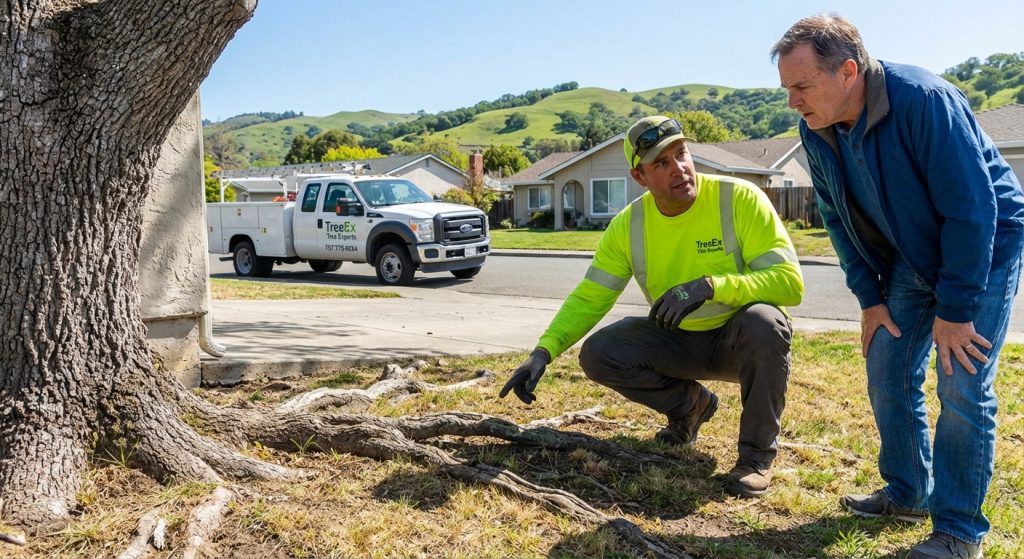
You notice a crack running up your foundation wall. Or maybe your driveway has started to heave on one side. You look around and there’s a large tree 10 feet away. Your first thought: are the roots causing this?
It’s a valid concern. Tree roots can absolutely damage foundations, driveways, sidewalks, and underground pipes. But it’s not as simple as “tree near house equals foundation damage.” Some trees are worse than others, some soils make the problem more likely, and sometimes what looks like root damage is actually something else entirely.
Here’s what Santa Rosa homeowners need to know about tree roots and your home’s foundation.
How Tree Roots Actually Damage Foundations
There’s a common misconception that tree roots grow toward your foundation and push through the concrete. That’s not usually how it works. Roots don’t have the force to crack a healthy, well-built foundation by pushing against it.
If you’re looking for a reliable tree removal company in Santa Rosa, understanding these details helps you make better decisions.
What actually happens is more indirect – and it has a lot to do with our soil here in Santa Rosa.
Soil Shrinkage and Expansion
Much of Santa Rosa sits on clay-rich soil. Clay soil expands when it’s wet and shrinks when it dries out. Tree roots draw moisture from the soil through a process called transpiration – a large oak can pull 50 to 100 gallons of water from the ground per day during summer.
When roots dry out the soil near your foundation, the clay shrinks and the soil contracts. This creates uneven settling – one part of the foundation drops while the rest stays put. That differential settlement is what causes cracks.
This is especially common in areas with heavy clay soil like parts of Bennett Valley, South Park, and the flat neighborhoods west of Highway 101.
Direct Root Growth
While roots rarely crack a solid foundation, they can exploit existing weaknesses. If your foundation already has a small crack or a joint that’s separated, roots will grow into it seeking moisture. Over time, the root thickens and widens the crack. This is more common with older homes that have foundations with minor deterioration.
Surface Root Damage
Above ground, roots are more obviously destructive. Surface roots can lift and crack driveways, sidewalks, patios, and retaining walls. This is purely mechanical – the root grows in diameter over the years and physically pushes up whatever is on top of it.
Which Trees Are Most Likely to Cause Root Problems?
Not all trees are equal when it comes to root damage. Some species are far more aggressive than others.
High risk (aggressive root systems):
- Coast Live Oak – extensive lateral root system, very common in Santa Rosa neighborhoods
- Valley Oak – deep and wide root system, massive trees that dominate many Santa Rosa properties
- Redwood – shallow, spreading root system that can extend 50+ feet from the trunk
- Eucalyptus – aggressive water-seeking roots, notorious for infiltrating pipes and foundations
- Willow – extremely aggressive water-seeking roots, worst offender for sewer lines
- Silver Maple – shallow surface roots that lift driveways and sidewalks
Lower risk (less aggressive root systems):
- Madrone – deep taproot, less lateral spreading
- Japanese Maple – compact root system suited to residential lots
- Crape Myrtle – small to medium tree with manageable roots
- Most fruit trees – limited root spread, rarely cause structural issues
If you have a large oak, redwood, or eucalyptus within 20 feet of your foundation, it’s worth monitoring for signs of root interference.
Signs That Tree Roots May Be Affecting Your Foundation
How do you know if roots are the culprit? Look for these indicators:
Diagonal cracks in foundation walls. Cracks that run diagonally (at roughly 45 degrees) from corners of windows or doors often indicate differential settling – which can be caused by roots drying out the soil unevenly.
Doors or windows sticking. If doors that used to close fine are suddenly sticking or not latching, the frame may have shifted due to foundation movement.
Uneven floors. A marble test – place a marble on the floor and see if it rolls – can reveal subtle settling that isn’t visible to the eye.
Visible surface roots near the house. If you can see thick roots at the surface running toward your foundation, there are almost certainly more roots underground doing the same thing.
Cracked driveway or walkway adjacent to the tree. Lifted or cracked concrete within the root zone of a tree is a strong indicator of root activity.
Slow drains or recurring sewer backups. Tree roots infiltrating sewer lines is extremely common. If your drains are slow and a plumber finds root intrusion, the tree is the source.
Not all foundation cracks are caused by trees. Soil settlement, poor drainage, seismic activity, and original construction defects can all cause similar symptoms. If you’re not sure, get both a structural assessment and a tree evaluation.
What to Do If Roots Are Damaging Your Foundation
If you’ve confirmed that tree roots are contributing to foundation problems, you have a few options – and removing the tree isn’t always the right one.
Root Barrier Installation
A root barrier is a physical wall – usually heavy-duty plastic or fiberglass – installed in a trench between the tree and your foundation. The barrier redirects root growth downward and away from the structure. This is the least disruptive option and works well when the tree is 15+ feet from the foundation.
Cost: $500 to $2,500 depending on the length and depth of the barrier.
Selective Root Pruning
An arborist can cut specific roots that are growing toward the foundation while preserving the roots the tree needs for stability and health. This is a targeted approach, but it carries risk – cutting too many roots on one side can make the tree unstable.
Root pruning should only be done by a certified arborist who understands the tree’s root structure and can assess the stability implications.
Tree Removal
If the tree is too close to the foundation, the roots are already causing significant damage, and a barrier won’t solve the problem – removal may be the best option. This is especially true for large trees within 10 feet of the foundation on clay soil.
Keep in mind that in Santa Rosa, many trees – particularly oaks and redwoods – are protected and require a permit to remove. An arborist report documenting the root damage and structural threat will support your permit application.
Foundation Repair
If roots have already caused foundation damage, you’ll likely need both tree work and foundation repair. Addressing the tree without fixing the foundation – or fixing the foundation without addressing the tree – means the problem will come back.
Can You Plant a Tree Near Your Foundation?
If you’re thinking about planting a new tree, placement matters. The general rule of thumb:
- Small trees (mature height under 30 feet): Plant at least 10 feet from the foundation
- Medium trees (30-50 feet): Plant at least 20 feet from the foundation
- Large trees (50+ feet): Plant at least 30 to 50 feet from the foundation
These distances aren’t just about roots hitting the foundation – they account for the soil moisture changes that the tree’s root system will create. On Santa Rosa’s clay soils, give large trees more room rather than less.
Also consider the direction of growth. A tree planted 30 feet to the south of your house will grow roots in all directions, including toward the house. But the root growth toward the house will be limited by the shade and dryness the house creates. A tree the same distance to the west, with full sun exposure toward the house, may send more roots in that direction.
What About Sewer and Water Lines?
Tree roots don’t just threaten foundations. Sewer lines are actually a more common target because they contain water and nutrients that roots seek out.
Older homes in Santa Rosa – particularly in Downtown, Railroad Square, and the older sections of West End – often have clay or cast-iron sewer pipes with joints that roots can infiltrate. Modern PVC pipes are more root-resistant, but not immune.
Signs of root infiltration in your sewer line:
- Slow drains throughout the house (not just one fixture)
- Gurgling sounds from toilets
- Recurring backups that clearing doesn’t permanently fix
- Wet spots or lush patches in the yard over the sewer line path
A plumber can run a camera inspection to confirm root intrusion. If roots are in your sewer line, you’ll need both a plumbing fix (repair or replace the pipe section) and tree work (root pruning or root barrier) to prevent recurrence.
Frequently Asked Questions
How far do tree roots extend from the trunk?
A common rule of thumb is that roots extend 2 to 3 times the width of the canopy. A tree with a 30-foot canopy spread may have roots reaching 60 to 90 feet from the trunk. Most structural damage occurs within the first 20 feet, where roots are largest and most concentrated.
Will removing a tree fix my foundation problem?
Removing the tree stops future root growth and moisture extraction, but it won’t reverse damage that’s already occurred. You’ll still need foundation repair for existing cracks and settlement. In some cases, removing a large tree can actually cause temporary additional settling as the soil rehydrates and adjusts.
Can tree roots crack a concrete slab foundation?
Surface roots can lift and crack thin concrete like driveways and sidewalks (typically 4 inches thick). A standard residential slab foundation (6-8 inches with rebar) is much harder for roots to physically crack. The bigger risk to slab foundations is differential settling caused by moisture changes in the soil, not direct root pressure.
My neighbor’s tree roots are damaging my property. Who pays?
You have the right to cut roots at the property line, at your expense. If a neighbor’s tree roots are causing significant structural damage to your home and they’ve been notified but refuse to act, they may be liable. This is a situation where documentation and potentially legal counsel are important.
Should I get an arborist or a structural engineer?
Both, if you suspect root-related foundation damage. An arborist assesses the tree – species, root system, whether the roots are reaching the foundation, and what tree work is needed. A structural engineer assesses the foundation – whether the damage is structural, what’s causing it, and what repair is needed. You need both perspectives for a complete picture.
Worried about tree roots near your foundation? TreeEx can send a certified arborist to evaluate the situation, identify the risk, and recommend the right course of action – whether that’s root pruning, a barrier, or tree removal. We serve all of Santa Rosa from Fountaingrove to Proctor Terrace.
As a trusted certified arborist in Santa Rosa, we handle jobs of all sizes across the city and surrounding areas.
Find us on Google Maps – look up Santa Rosa arborist services to see our reviews and service area.
Call TreeEx at (707) 775-0204 for a free root assessment.